
Applications
No Sample Left Behind
From cfDNA to Single Cells to FFPE Archives: Precious, Limited, and Degraded Samples Finally Get the Workflow They Deserve
Every molecule matters when your starting material is scarce, degraded, or irreplaceable. iconPCR™ with AutoNorm™ monitors amplification in real time, stopping every reaction at the sample-specific optimal endpoint — so nothing is wasted, nothing is over-cycled, and no sample gets left behind.
cfDNA: Every Nanogram is Non-Negotiable
Pushing Variant Detection to 0.5% Allele Frequency from 1 ng Input
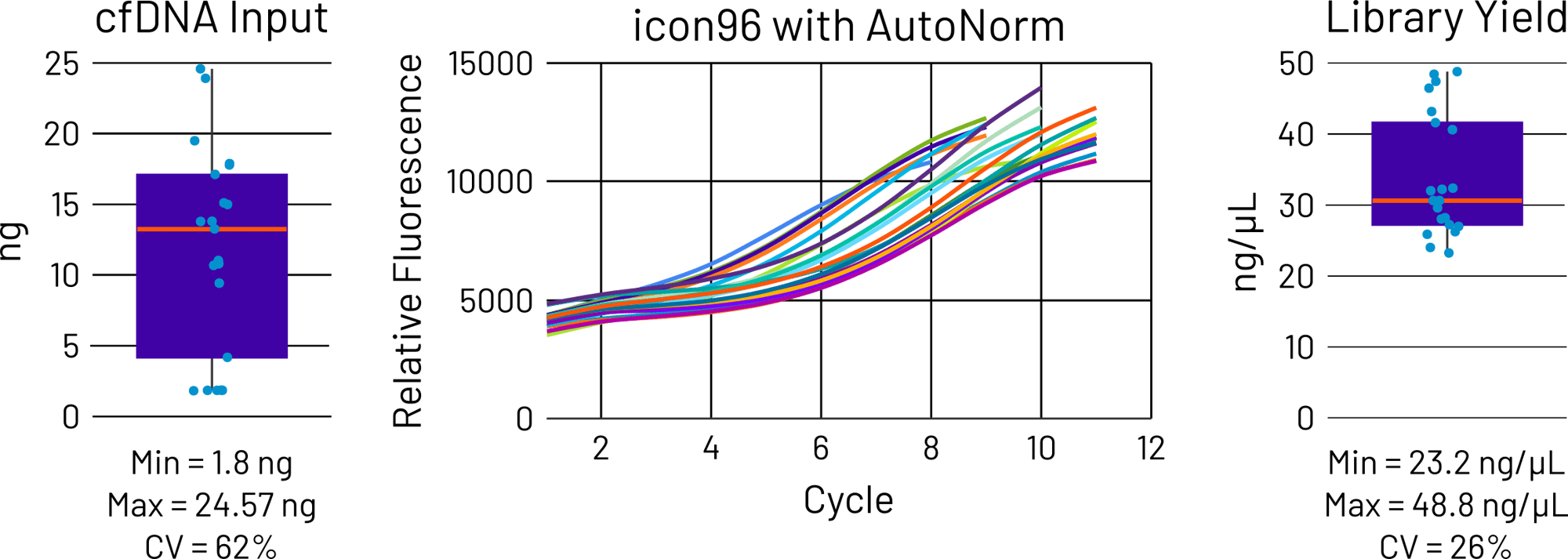
Cell-free DNA leaves no room for PCR error. Standard fixed-cycle amplification produces a 54% coefficient of variation in library yield, even across identical 10 ng inputs. The team at Dana-Farber Cancer Institute's Molecular Biology Core Facilities integrated icon96 with AutoNorm into a targeted cfDNA workflow and cut that CV to 8%, co-processed 1 ng and 10 ng samples in a single run, and achieved reliable mutation detection down to 0.5% variant allele frequency.
- CV of library yield: 54% (standard PCR) → 8% (AutoNorm) at 10 ng input
- 1 ng and 10 ng samples co-processed in a single run
- >90% on-target capture efficiency; reliable VAF detection to 0.5%
- Validated at Dana-Farber Cancer Institute Molecular Biology Core Facilities
FFPE DNA: Rescue Every Read
Don't Sequence Them Like You Did Last Year
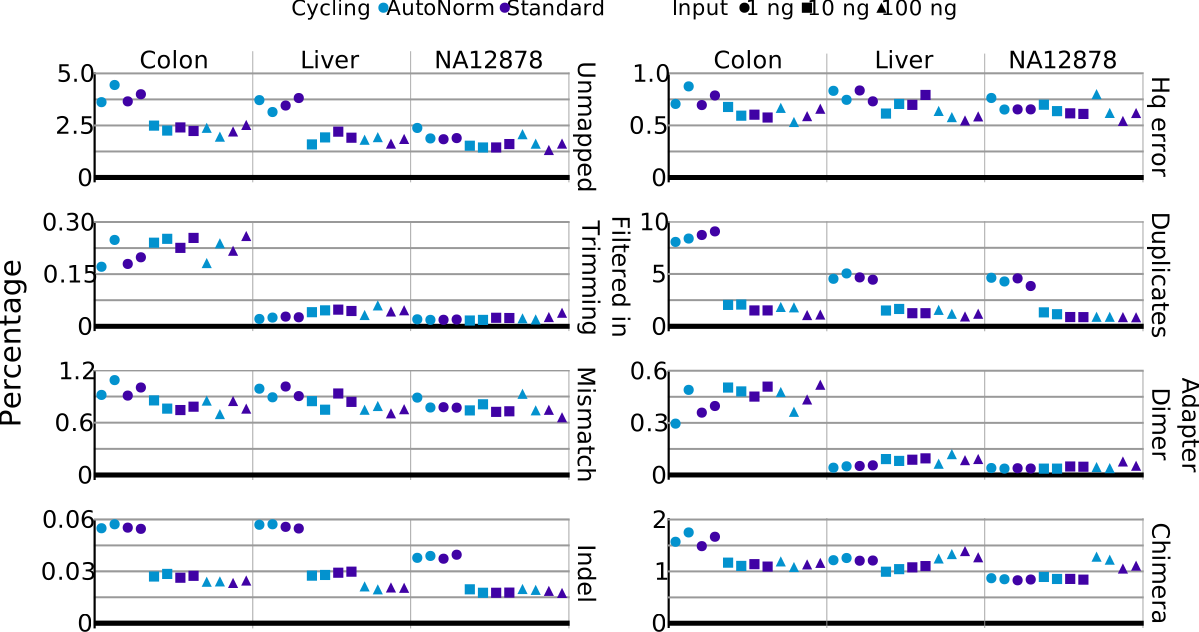
FFPE samples are chemically damaged, unpredictably fragmented, and nearly impossible to accurately quantify before PCR. Fixed-cycle amplification treats every well the same, producing dropouts from under-cycled samples and artifacts from over-cycled ones. iconPCR with AutoNorm monitors fluorescence in each of its 96 individually controlled wells and stops every reaction at its sample-specific optimal endpoint, delivering consistent library yields from 1 ng to 100 ng in a single run on a single instrument.
- Eliminates pre-pooling quantification steps
- Reduces dropouts and over-amplification artifacts in clinical-grade FFPE specimens
- Processes samples at 1 ng, 10 ng, and 100 ng input simultaneously on one instrument
Single Cell RNA-Sequencing
Every Cell Counts: Single Cell RNA-Seq, Perfected
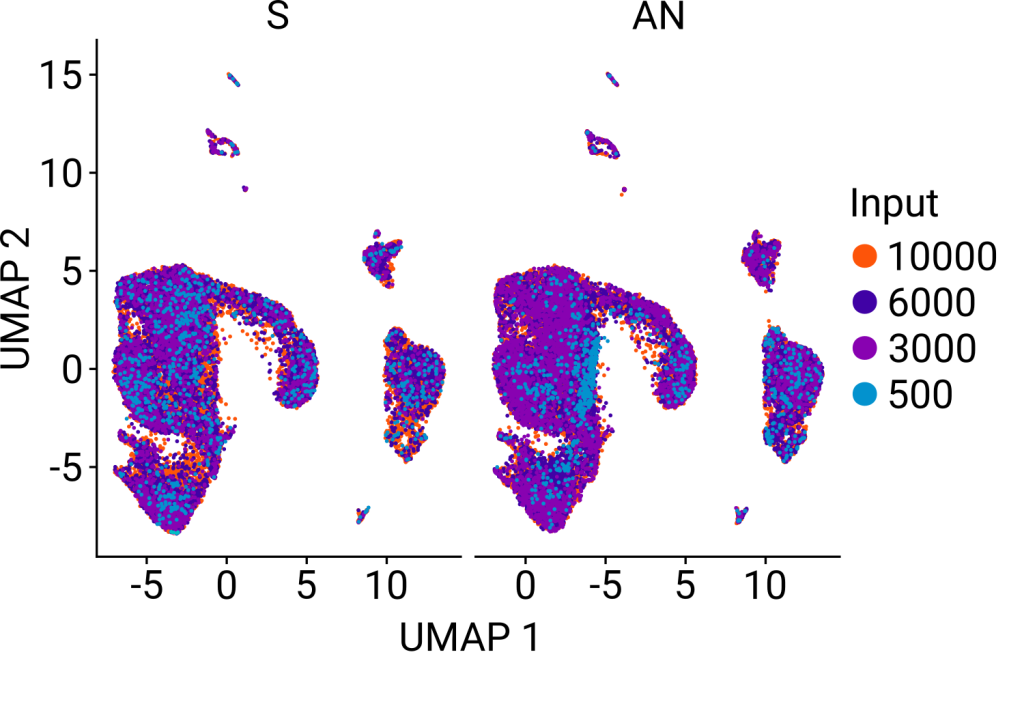
Standard single-cell workflows require batching samples by cell count across multiple thermocycler runs, with a quantification step in between. Using 10x Genomics GEM-X libraries across 500 to 10,000 cell inputs, icon96 with AutoNorm replaced six standard thermocycler runs with just two, reduced total PCR cycles by 5 to 6 per sample, and eliminated the need for pre-index-PCR quantification, all with no detectable difference in UMAP clustering or gene signature detection.
- 6 thermocycler runs (standard) → 2 runs (AutoNorm) for 16 samples across 4 cell inputs
- AutoNorm reduced total PCR cycles by 5 to 6 per sample vs. standard protocol
- No loss of data quality: UMAP clustering and library fragment profiles identical between methods
- No pre-index-PCR quantification required
- Validated in collaboration with Rush University Genomics and Microbiome Core Facility
FFPE RNA-Sequencing
Over-Amplification: Silently Degrading Your Gene Counts
With FFPE RNA, too many PCR cycles directly damages your data: aligned read rates fall, duplicate rates climb, and detected gene counts drop. There is no way to know the damage has occurred until sequencing comes back wrong. iconPCR with AutoNorm stops each library in the linear phase of its own amplification curve, preserving data integrity across 1 ng to 100 ng of FFPE RNA input — across variable DV200 scores, in a single run, replacing up to three separate fixed-cycle thermocycler runs.
- Prevents over-amplification-driven loss of gene count and alignment rate
- All FFPE RNA inputs — regardless of amount or degradation — processed in one run
- Compatible with integrated NEB RNA-seq library prep chemistries for end-to-end workflow optimization
.webp "FFPE RNA-Sequencing app note")